
What Documents Are Required for an International B2B Transaction?
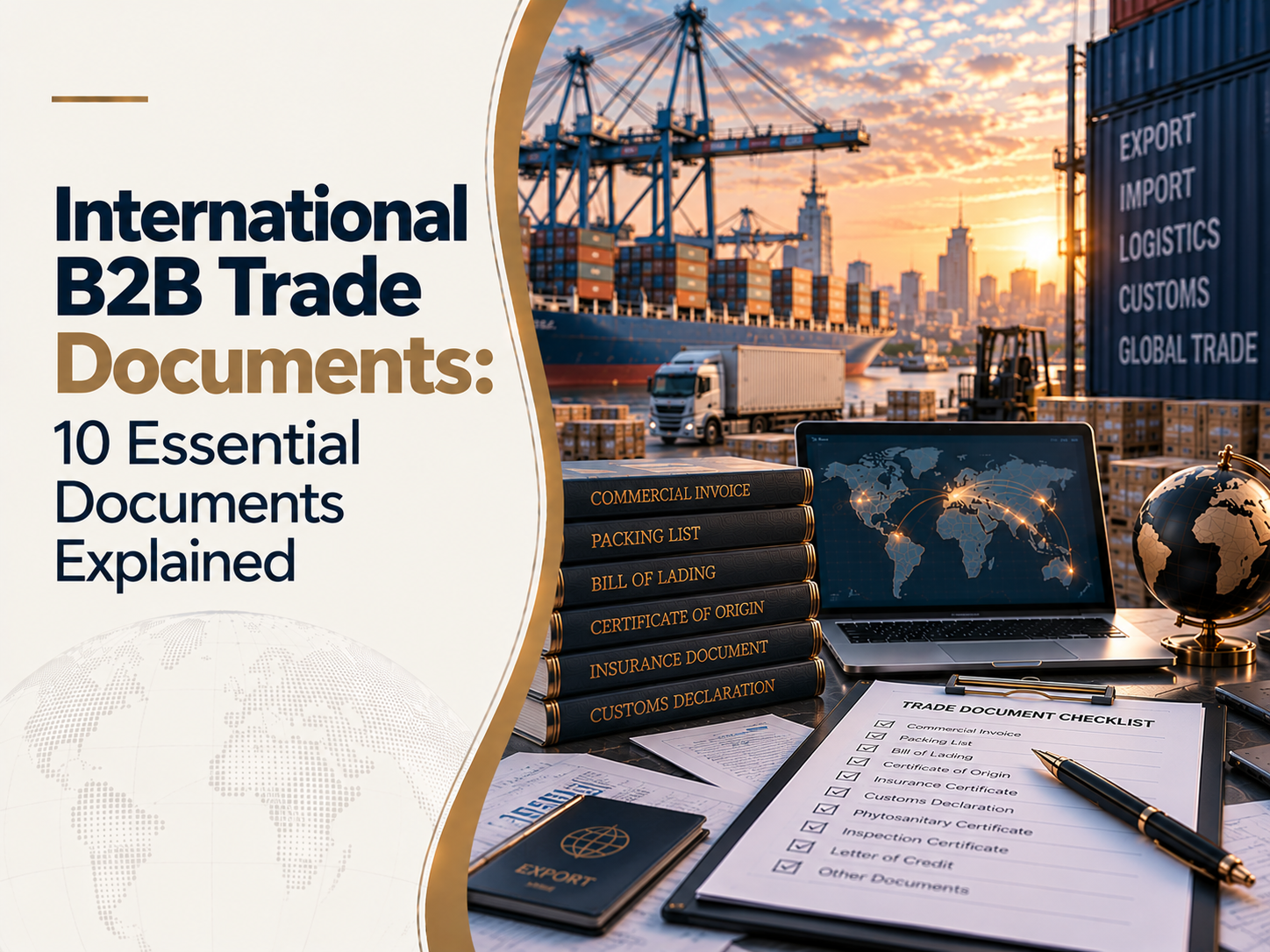
International B2B transactions involve more than agreeing on a price and arranging delivery. Businesses must prepare the right documents to confirm the order, define contractual responsibilities, arrange payment, transport goods, and comply with customs regulations.
The exact requirements depend on the product, the countries involved, the shipping method, and the payment terms. However, several documents are commonly used in international trade and should be considered before a shipment leaves the supplier.

1. Sales Contract
A sales contract defines the terms agreed between the buyer and seller. It provides a written reference if disagreements arise during the transaction.
A well-prepared international sales contract should specify:
Product descriptions, specifications, and quantities
Unit prices, total value, and currency
Payment method and payment deadlines
Delivery terms and the applicable Incoterm
Delivery schedule and destination
Quality requirements, inspection, and acceptance procedures
Warranty, liability, and dispute-resolution provisions
For complex or high-value orders, the contract should also address applicable law, force majeure, and remedies for non-performance.
2. Purchase Order (PO)
The buyer issues a purchase order to formally request goods or services from a supplier. It typically identifies the products, quantities, prices, delivery requirements, and payment terms.
The supplier may confirm the purchase order through an order acknowledgment, or another agreed acceptance process.
A purchase order helps both parties maintain a clear record of what was ordered and reduces misunderstandings about product specifications, quantities, and delivery dates.
3. Pro Forma Invoice
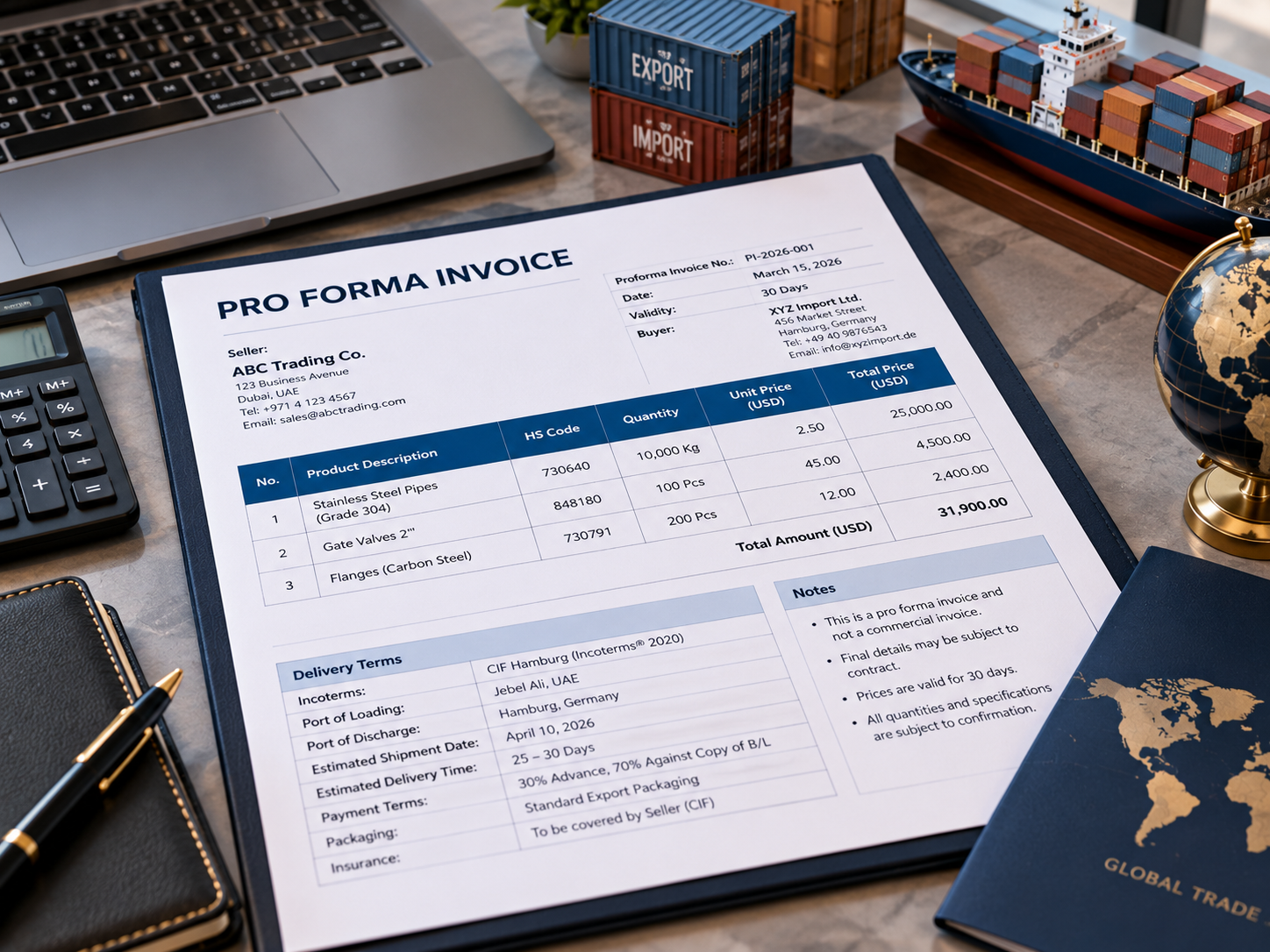
A pro forma invoice is a preliminary document that outlines the expected transaction before the final commercial invoice is issued.
It commonly includes:
Seller and buyer details
Product descriptions and quantities
Estimated prices and total value
Proposed delivery terms
Payment conditions
Expected shipment details
Buyers often use a pro forma invoice to obtain internal approval, arrange advance payment, or support certain import-permit or banking procedures. Whether it is accepted for a particular purpose depends on the relevant authorities and financial institution.
4. Commercial Invoice
The commercial invoice records the actual sale of goods and is a key document for customs valuation and international payment processes.
It generally includes the seller's and buyer's details, invoice number and date, product descriptions, quantities, prices, currency, country of origin (where relevant), and agreed delivery terms.
Customs authorities may use the information to assess the goods' value and applicable duties and taxes. Incorrect product descriptions, inconsistent values, or missing details can delay clearance.
The commercial invoice should match the purchase order, sales contract, packing list, and other shipment documents.
5. Packing List
A packing list describes how the goods are packed for transportation. It helps logistics providers, customs authorities, and receiving teams identify and verify the shipment.
Typical details include:
Number of packages, cartons, pallets, or crates
Contents of each package
Net and gross weight
Package dimensions
Marks and package numbers
Unlike a commercial invoice, a packing list focuses on the physical contents and packaging rather than the financial value of the sale.
Accurate weights and dimensions are particularly important when shipping industrial equipment, oversized cargo, or palletized goods.
6. Transport Document
The transport document confirms or records key shipment details. The type required depends on the transportation method.

Bill of Lading (B/L)
Used in sea freight. Depending on its form, it can serve as a receipt for the goods, evidence of the contract of carriage, and a document of title.

Air Waybill (AWB)
Used in air freight as a shipment receipt and evidence of the air carriage contract. It is generally not a document of title.

CMR Consignment Note
Commonly used for international road transport subject to the CMR Convention. It records important details about the sender, carrier, consignee, and goods.
The buyer and seller should confirm which transport document is needed and whether originals, electronic records, or specific document formats are required.
7. Certificate of Origin
A certificate of origin identifies the country where goods qualify as originating under the applicable origin rules. It may be requested by customs authorities, buyers, or banks.
Origin can affect customs duties, trade-policy measures, and eligibility for preferential tariffs under relevant trade agreements.
A certificate of origin does not automatically establish eligibility for reduced duties. Preferential treatment usually requires compliance with the applicable rules of origin and the correct supporting proof.
8. Customs Declarations and Export or Import Permits
Many international shipments require customs declarations submitted to the relevant authorities. Depending on the country and product, you may also need additional permits, licenses, or regulatory documents.
Examples include:
Export or import licenses for controlled products
Product-specific permits
Safety or conformity documentation
Sanitary or phytosanitary certificates for certain goods
Dangerous goods declarations where applicable
Requirements can differ significantly for food, chemicals, medical devices, electronics, machinery, and dual-use items. Businesses should verify the rules for the specific product and destination before shipment.
9. Certificate of Conformity and Other Product Certificates
Some products must meet technical, safety, environmental, or labeling requirements before they can be placed on a market.
Depending on the product and destination, documentation may include a declaration of conformity, test reports, inspection certificates, or other regulatory evidence.
For example, certain products placed on the EU market may require CE marking and an EU Declaration of Conformity. Other markets may require different registrations, approvals, or certificates.
Not every shipment needs a certificate of conformity. Confirm the exact product category and destination requirements before placing an order.
10. Insurance and Payment Documents
Two additional document categories may matter, depending on the transaction.
Cargo Insurance Certificate or Policy
Cargo insurance documents show the insurance cover arranged for a shipment. They may specify the insured goods, coverage period, insured value, and applicable risks.
Whether insurance is required by the contract depends partly on the agreed Incoterm. For example, CIF and CIP impose insurance obligations on the seller under Incoterms 2020, but the required level of cover differs.
Payment Documents
The payment method determines which additional documents may be required.
For a documentary letter of credit, the issuing bank sets out the documents the seller must present. These may include a commercial invoice, transport document, packing list, insurance document, and certificate of origin.
Even small discrepancies between the documents and the letter-of-credit terms can delay payment processing.
How to Prepare Your Documents Before Shipment
Before goods are dispatched, businesses should use a consistent document-checking process:
Confirm the transaction terms. Check the contract, purchase order, payment method, and named Incoterm location.
Verify product and destination requirements. Identify customs rules, permits, certificates, and labeling requirements.
Match the documents. Check that product descriptions, quantities, values, weights, addresses, and shipment references agree across the paperwork.
Confirm the required format. Determine whether authorities, carriers, or banks need originals, copies, electronic documents, or specific wording.
Coordinate with the logistics provider. Confirm transport bookings, shipping instructions, and the documents needed for clearance.
Keep organized records. Retain contracts, invoices, declarations, certificates, and payment records as required by applicable legal and tax requirements.
The goal is not to prepare every possible document for every transaction. It is to identify the documents that apply to the specific goods, countries, transport route, and payment arrangement.
Make International B2B Transactions More Reliable with Capella Austria
Accurate documentation helps businesses reduce shipping delays, avoid customs complications, and keep communication clear with international suppliers and buyers.
Capella Austria supports businesses exploring international sourcing and cross-border trade. Whether you are purchasing industrial equipment, evaluating a supplier, or preparing for a new international transaction, clear requirements and well-organized documentation can help you move forward with greater confidence.
Contact Capella Austria to discuss your sourcing needs and prepare for your next international B2B transaction.
Frequently Asked Questions
1. What are the most important documents in international B2B trade?
Commonly required documents include a commercial invoice, packing list, transport document, and customs declaration. Depending on the transaction, you may also need a sales contract, purchase order, and certificates.
2. Is a sales contract always required?
Not every transaction requires a separate signed contract by law, but a written agreement is strongly recommended, especially for high-value or complex international orders.
3. What is the difference between a pro forma invoice and a commercial invoice?
A pro forma invoice outlines a proposed transaction, while a commercial invoice records the sale for commercial and customs purposes.
4. Who prepares the commercial invoice?
The seller or exporter usually issues the commercial invoice. The buyer should check that the details match the agreed order and applicable customs requirements.
5. Is a packing list mandatory for every shipment?
Requirements vary by country, carrier, and shipment type. A packing list is commonly used and may be required for customs clearance or logistics handling.
6. Do all international shipments require a certificate of origin?
No. It depends on customs requirements, the destination, the product, the buyer's request, and whether preferential tariff treatment is being claimed.
7. What documents are needed to import industrial machinery?
Depending on the origin and destination, documents may include a commercial invoice, packing list, transport document, customs declaration, origin evidence, and product-specific permits or conformity documentation.
8. What documents are needed for payment by letter of credit?
The bank's letter-of-credit terms determine the required documents. Common examples include a commercial invoice, transport document, packing list, insurance document, and certificate of origin.
9. Can incorrect documents delay customs clearance?
Yes. Inconsistent values, inaccurate product descriptions, missing permits, or incorrect shipment details can result in additional checks, delays, or penalties.
10. How can a business confirm which documents are required?
Check the destination country's customs and regulatory requirements, consult the freight forwarder or customs broker, and review any applicable banking and contractual conditions before shipping.